
Why You Should Never Share UPI PIN

UPI has made digital payments simple and fast. You can send money anytime. You can pay bills in seconds. You can shop without cash. However, this convenience also increases the risk of fraud. That is exactly why you should never share your UPI PIN with anyone. Your UPI PIN is the final security layer between your bank account and fraudsters. If it is exposed, your money can be stolen instantly.
What is a UPI PIN?
1. A Secret Authorization Code
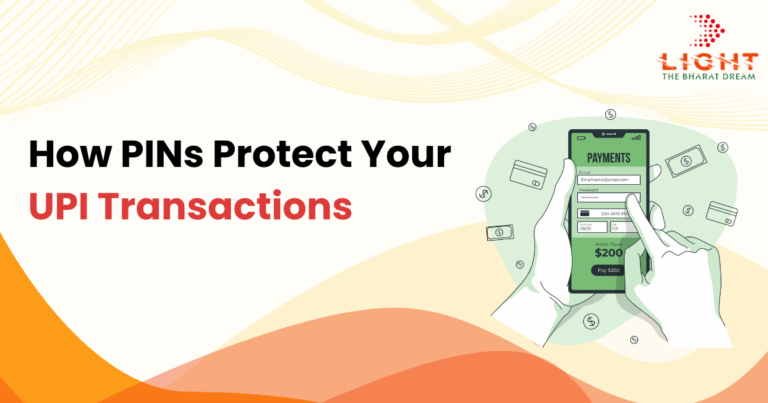
A UPI PIN is a 4 or 6-digit confidential number. It is created while setting up UPI on your banking app. Every time you approve a payment, you must enter this PIN. Therefore, it acts as your digital signature.
2. Directly Linked to Your Bank Account
Unlike Digital wallets, UPI connects directly to your bank account. As a result, any approved transaction moves money straight from your bank. There is no waiting period; it is done directly.
3. Required Only for Sending Money
One important rule to remember is this: you only enter your UPI PIN to send money. You never need it to receive money. Therefore, if someone asks you to enter your PIN to “get” funds, it is a scam.
Common Situations Where People Share Their UPI PIN
1. Fake Customer Care or Bank Officials
False calls are one of the most widespread types of scams. The caller identifies himself as a customer of your bank or a payment application. They can tell you that your account is going to be blocked. Or they can speak of suspicious activity. Once they have caused panic, they request you to enter your UPI PIN in order to either verify or fix the problem. Nonetheless, this is absolutely untrue. Authentic bank officials do not request your PIN, OTP, or passwords. In case a person asks about such information, hang up the phone.
2. Payment Request Confusion
There is another popular scam, which is called collect money. You can get an email requesting you to confirm payment. The fraudster can inform you that you need to enter your PIN in order to get money. The fact is that when you enter your UPI PIN for a transaction, a payment will be made in your account. Consequently, you send instead of receiving money. Be careful, therefore, whenever you read payment notifications before giving any consent.
3. QR Code Fraud
QR code frauds are on the rise. To receive a refund or payment, a fraudster can request you to scan a QR code. Once scanning, you are asked to type in your UPI PIN. Nevertheless, when you scan a QR code and input your PIN, it is likely that you are about to pay somebody. Money is therefore deducted from your account. Never forgetting to use a QR code or a PIN to obtain money is unnecessary.
4. Online Marketplace Scams
In selling goods online, fraudsters tend to impersonate true purchasers. They can make counterfeit payment receipts or Photoshop screens. Afterwards, they request that you authorize a payment request with your UPI PIN. Unluckily, they are allowed to access the money in your account. That is why screenshots should not be trusted in the first place. I would always verify my bank balance from my official app before making any decision.
Practical Steps to Protect Your UPI PIN
1. Keep Your PIN Private at All Times
Your PIN UPI is very confidential. As such, never disclose it to any person. Not with friends. Not with relatives. Even when one is purporting to be in your bank. It is important to remember that the banks or other payment applications will never require your PIN. When a person asks about it, that is a very obvious warning. Besides, do not type your PIN in front of others. In case you are in an open area, please ensure that no one is staring at your screen. It is your own business to be financially secure.
2. Choose a Strong and Unique PIN
A good PIN complicates the guessing of fraudsters of your information. So, you should not use such easy combinations of numbers as 1234, 0000, or your date of birth. Such are prime targets of fraudsters. Rather, generate a random number that does not even have any direct relation to your personal information. Also, do not use the same PIN on several banking applications. A special PIN provides additional security to your account.
3. Enable App Lock and Alerts
There is a reason why security features are present. So, make full use of them. Turn on fingerprint/face identification on your UPI apps. In such a manner, in case someone gains access to your phone, he or she cannot access your payment app with ease. Besides, enable SMS and email transaction notification. These alerts make you know immediately when it is debited or credited with money. Consequently, you can easily detect bad activity and take appropriate measures immediately.
4. Regularly Update Your PIN
Changing your UPI PIN from time to time is a smart habit. Even if you believe your PIN is safe, periodic updates reduce long-term risks. Indicatively, in the event that your PIN has been accidentally disclosed, a change in urgency reduces damages. Thus, think about switching PIN regularly (after every several months). This is one of the basic actions that can enhance your general online security.
Final Words
Electronic fund transfer is time-efficient and effective. Nevertheless, security has to be the priority. PIIN is the password to your bank account. It is secretive and potent. Thus, keep it safe and do not disclose it under pressure. Never forget the reason why you must never give any of your UPI PIN, as this is the easiest way to guard your hard-earned money against fraud.